Moving with Support – Yoga Therapy for Parkinson’s
By Christina Sanders RMT, C-IAYT Yoga Therapist, Accessible Yoga Teacher at Your Discovery & Journey -Yoga Therapy and Wellness
April is Parkinson’s Awareness Month. A time to deepen understanding, support, and compassionate care for those living with Parkinson’s disease. Parkinson’s affects movement, balance, coordination, and overall well-being. Therapeutic yoga offers a gentle, evidence-informed approach to supporting both motor and non-motor symptoms. Through mindful movement, breath, and nervous-system regulation, individuals can build stability, confidence, and a renewed sense of connection with their bodies. In this week’s article, we explore how yoga therapy supports Parkinson’s disease and how individualized care can enhance quality of life.
National Parkinson’s Awareness Month
April invites awareness. Organizations such as Parkinson Canada shares not only the challenges of living with Parkinson’s, but also the importance of support, dignity, and quality of life.
Parkinson’s is a progressive neurological condition that affects movement, coordination, and many aspects of daily life. It is commonly associated with tremor, rigidity, and slowed movement, but it also includes a wide range of non-motor symptoms such as sleep disruption, mood changes, and fatigue (Parkinson Canada, n.d.; Grimes et al., 2019).
If you are living with Parkinson’s, or supporting someone who is, you may already know that each experience is unique. Some days may feel more steady. Other days may feel less predictable. There is no single right way to move through this. For many individuals, Parkinson’s is not experienced as a single set of symptoms but as a changing and deeply personal process.
Yoga Therapy offers one possible form of support, one that is gentle, adaptable, and centered on meeting you where you are. Therapeutic yoga invites you to move at your own pace, pause or rest when needed, and choose what feels supportive.
Understanding Parkinson’s in the Body
Parkinson’s disease is associated with the degeneration of dopamine-producing neurons, affecting how movement is initiated and coordinated (Grimes et al., 2019). This can lead to:
- Changes in balance and gait
- Increased muscle rigidity
- Reduced movement amplitude
- Postural instability
- Fatigue and decreased confidence in movement
At the same time, non-motor symptoms such as anxiety, depression, and sleep disruption are widely recognized as part of the condition and can significantly impact quality of life (Parkinson Canada, n.d.). These experiences are not only physical. They involve the nervous system, energy levels, and emotional well-being. Because of this, supportive approaches benefit from being whole-body and adaptable.
What Is Yoga Therapy?
Yoga Therapy is not a general yoga class. It is a personalized, evidence-informed approach. The International Association of Yoga Therapists defines yoga therapy as “the professional application of the principles and practices of yoga to promote health and well-being within a therapeutic relationship…” In practice, this means:
- Movements are adapted to your capacity
- There is no expectation to push through discomfort
- Practices can shift from day to day
- Rest and choice are always included
This approach is especially important for Parkinson’s, where symptoms may fluctuate. And, because no two individuals experience Parkinson’s in the same way, therapeutic yoga meets the person where they are, adapting practices to support symptoms that day.
What the Research Shows
Research continues to explore how yoga may support individuals living with Parkinson’s. Studies suggest that yoga-based practices may:
Improve balance and stability
Yoga practices that include slow transitions, weight shifting, and supported standing movements have been shown to enhance postural control. This may help reduce fall risk and support greater confidence in everyday movement (Van Puymbroeck et al., 2018).
Support mobility and coordination
Gentle, repetitive movements paired with breath may help improve movement initiation and coordination. This can support smoother, more intentional movement patterns over time (Ni et al., 2016).
Reduce anxiety and depression
Mindfulness-based yoga has been shown to reduce symptoms of anxiety and depression, which are common non-motor experiences in Parkinson’s. These changes may support emotional well-being and resilience (Kwok et al., 2019).
Enhance overall quality of life
Participants in yoga-based programs often report improvements not only in physical symptoms, but also in their sense of connection, confidence, and ability to engage in daily activities (Van Puymbroeck et al., 2018).
Some research also suggests that mindful movement and breath practices may support nervous-system regulation and neuroplasticity. These practices may help shift the body toward a more regulated state, supporting resilience and adaptability (Streeter et al., 2012).
While yoga therapy is not a treatment for Parkinson’s, it can be a meaningful complementary support, particularly when adapted to the individual and practiced with attention to safety, pacing, and choice.
A Trauma-Informed Approach to Movement
A trauma-informed approach recognizes that the body may respond differently from moment to moment. In this work, we emphasize:
- Choice – you decide how and when to move
- Safety – movements are gentle and supported
- Awareness – noticing without judgment
- Pacing – allowing time for the body to respond
There is no expectation to “get it right.” Only an invitation to explore.
How Yoga Therapy May Support Parkinson’s
Yoga Therapy can support symptoms of Parkinson’s through several pathways:
- Gentle Movement & Coordination – Encouraging slow, intentional movement may support motor control.
- Balance & Stability – Supported balance work may help reduce fear of falling.
- Breath & Nervous-System Regulation – Breathing practices may support calm and reduce stress.
- Emotional Support – Movement and awareness may support mood and connection.
- Adaptability – Practices can be seated, supported, or standing.
What a Session May Feel Like
At Your Discovery & Journey Yoga Therapy and Wellness, sessions are:
- Individualized
- Trauma-informed
- Clinically grounded
- Adaptable to your needs
You may be guided through:
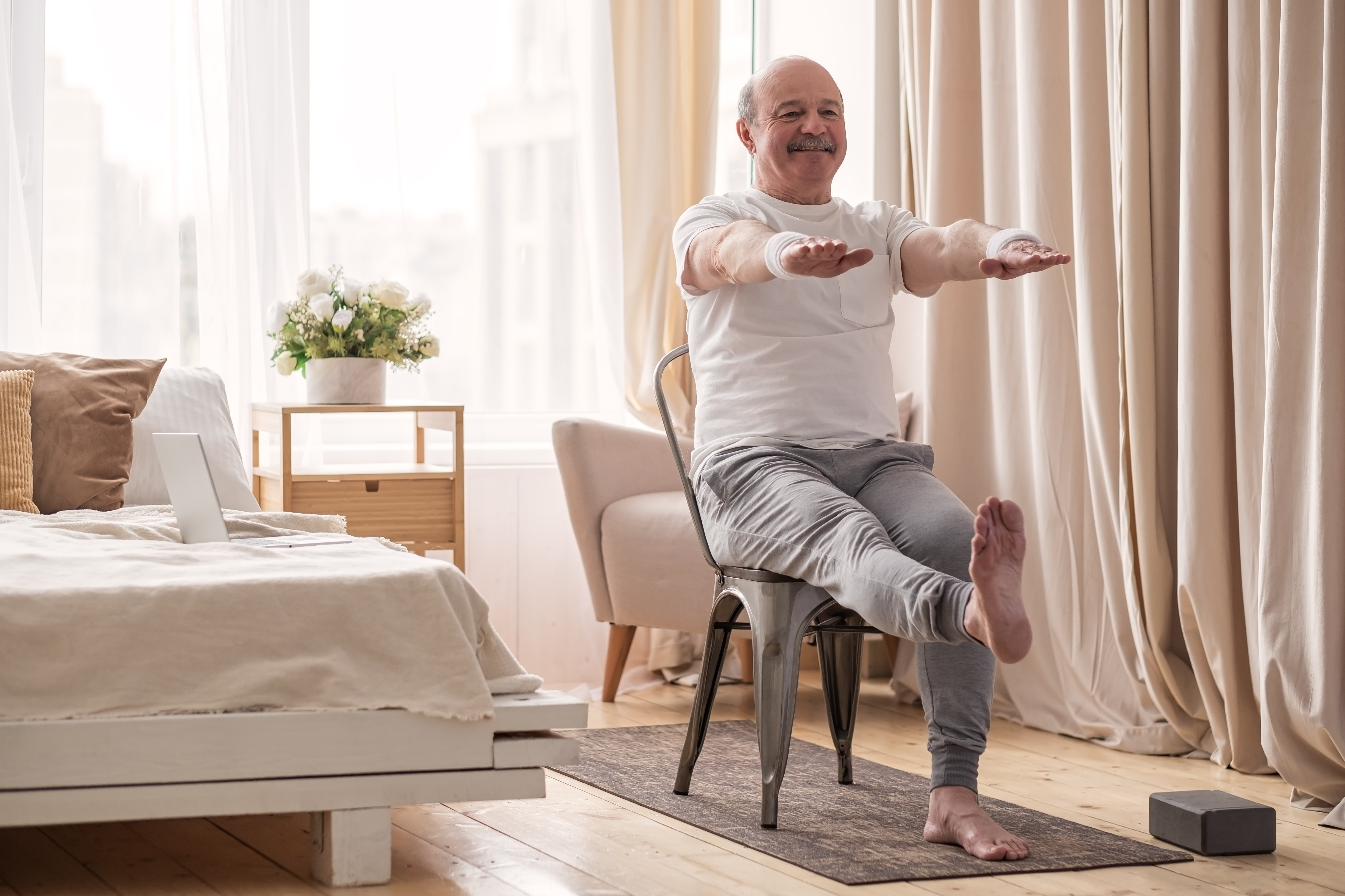
- Chair-based or supported movement
- Gentle coordination and balance exercises
- Breath regulation practices
- Postural awareness work
- Restorative practices for nervous-system support
You are always welcome to pause. Each session is individualized, paced appropriately, and designed to support long-term sustainability.
A Gentle Practice to Explore
If it feels appropriate, you might try this gentle sequence.
- Seated Grounding: Sit comfortably with feet on the floor. Notice your connection to the ground.
- Arm Raises with Breath: Inhale: slowly lift arms. Exhale: lower with control
- Seated Marching: Lift one foot at a time, slowly and with awareness.
- Neck Mobility: Gently turn the head side to side.
- Supported Standing (Optional): Hold a chair and gently shift weight from one foot to the other.
Move slowly. Rest as needed.
An Invitation During Parkinson’s Awareness Month
Parkinson’s Awareness Month reminds us that support can take many forms. Yoga Therapy is not about changing your body, rather supporting your relationship with it. If you are ready to explore how ask how Yoga Therapy may support you on your journey, reach out or book a free meet and greet to discuss more.
Book your session now at Your Discovery & Journey Yoga Therapy and Wellness. Serving Edmonton, Sherwood Park, Strathcona County, and online everywhere.
References
Parkinson Canada. (n.d.). What is Parkinson’s? https://www.parkinson.ca/about-parkinsons/what-is-parkinsons/
Parkinson Canada. (n.d.). Parkinson’s awareness month. https://www.parkinson.ca/get-involved/parkinsons-awareness-month/
International Association of Yoga Therapists. (n.d.). Contemporary definitions of yoga therapy. https://www.iayt.org/page/ContemporaryDefiniti
International Association of Yoga Therapists. (n.d.). Educational standards for yoga therapists. https://www.iayt.org/page/CurrentIllustrativeS
Grimes, D., Fitzpatrick, M., Gordon, J., Miyasaki, J., Fon, E. A., Schlossmacher, M., … Suchowersky, O. (2019). Canadian guideline for Parkinson disease. Canadian Journal of Neurological Sciences, 46(6), 585–596. https://doi.org/10.1017/cjn.2019.239
Kwok, J. Y. Y., Kwan, J. C. Y., Auyeung, M., Mok, V. C. T., Lau, C. K. Y., Choi, K. C., & Chan, H. Y. L. (2019). Effects of mindfulness yoga vs stretching and resistance training exercises on anxiety and depression for people with Parkinson disease: A randomized clinical trial. JAMA Neurology, 76(7), 755–763. https://doi.org/10.1001/jamaneurol.2019.0534
Ni, M., Signorile, J. F., Mooney, K., Balachandran, A., Potiaumpai, M., & Luca, C. (2016). Comparative effect of yoga on motor function in Parkinson’s disease. Archives of Physical Medicine and Rehabilitation, 97(3), 345–354. https://doi.org/10.1016/j.apmr.2015.10.095
Van Puymbroeck, M., Walter, A., Hawkins, B. L., Sharp, J. L., Woschkolup, K., Urrea-Mendoza, E., & Miller, K. K. (2018). Functional improvements in Parkinson’s disease following a randomized trial of yoga. Evidence-Based Complementary and Alternative Medicine, 2018, 8510876. https://doi.org/10.1155/2018/8510876
Streeter, C. C., Gerbarg, P. L., Saper, R. B., Ciraulo, D. A., & Brown, R. P. (2012). Effects of yoga on the autonomic nervous system. Medical Hypotheses, 78(5), 571–579. https://doi.org/10.1016/j.mehy.2012.01.021
Woodyard, C. (2011). Exploring the therapeutic effects of yoga. International Journal of Yoga, 4(2), 49–54. https://doi.org/10.4103/0973-6131.85485

Christina Sanders
CMMOTA Registered Massage Therapist, C-IAYT Yoga Therapist, RYT 500, Accessible Yoga Teacher
YOUR DISCOVERY AND JOURNEY
YOUR DISCOVERY AND JOURNEY
YOGA THERAPY & WELLNESS
By appointment only
#26 – 51069 Range Road 215, Sherwood Park, AB
(780) 902-5902
Leave a Reply